Tuesday, January 29, 2013

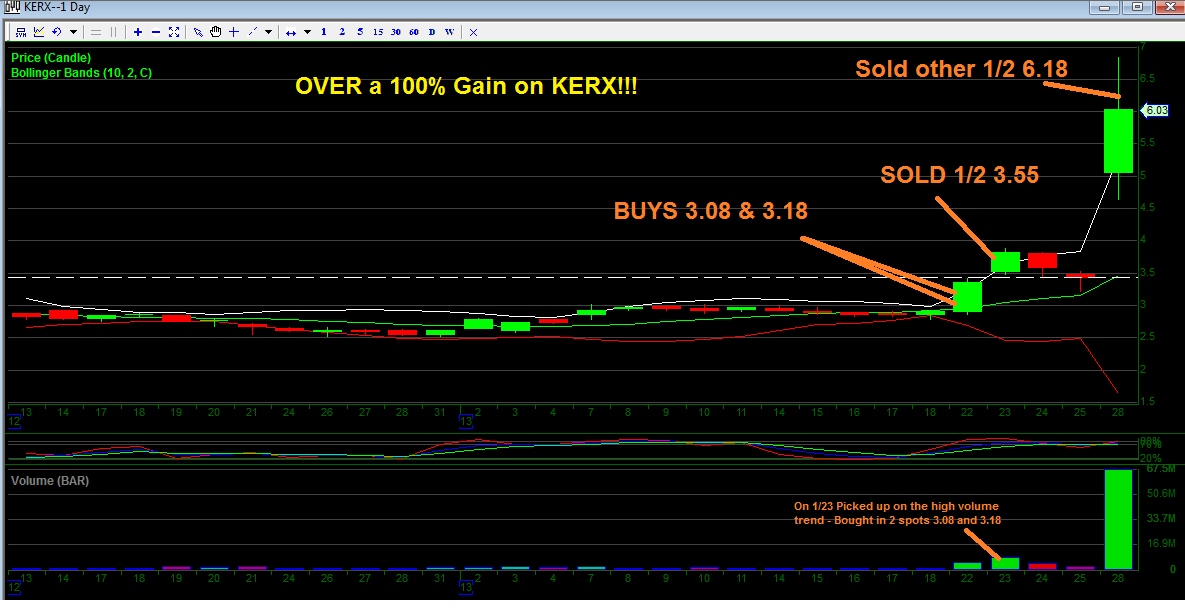
KERX & AEZS Swing Trades - 100% Gains


January 28, 2013
Protradermike picked Keryx Biopharmaceuticals Inc. (KERX) and Aeterna Zentaris Inc. (AEZS) in the past 3 days in both theMOJO Live Trading Room and now to be included in the new SwingTrade Newsletter.

Over the years, I have identified stock patterns that repeat themselves over and over again — these kinds of patterns can be very profitable if spotted early enough in the stocks upward move. I do extensive research to make sure only high probability setups and trades occur. My Strategies and Rules are simple and easy to teach but hard for an individual investor to follow by themselves with limited time, limited resources and limited support. I do all the research, identify high probability winners, and alert you in my trade room by not only chat but by audio commentary. You will get the full details on not only WHEN to BUY but HOW to BUY. Scaling in and out of positions is a method I teach consistently to my subscribers in order to maximize average pricing and increase trade win percentages. If you are an individual interested in high percentage stock picks you can either follow my Day Trading picks in the Live Trade Room or get my Swing Trading Alerts Newsletter.


Protradermike will do the research for you. Just sit back and follow his picks - you will get all setups with Entries, Exits, and Stops. Do not miss the next big stock market winner. Sign up Today!!

FREE TRIAL TO THE SWING TRADE ALERT NEWSLETTER
FIRST 50 SIGNUPS FREE - HURRY ACT NOW


Wednesday, January 9, 2013

U.S. Bank Partners With Mitek for Mobile Photo Bill Pay, Will Launch to Consumers in Early 2013


U.S. Bank Partners With Mitek for Mobile Photo Bill Pay, Will Launch to Consumers in Early 2013

MINNEAPOLIS and SAN DIEGO, Dec. 5, 2012 (GLOBE NEWSWIRE) -- U.S. Bank, fifth-largest bank in the United States and lead bank of U.S. Bancorp (USB), and Mitek Systems (MITK), a leading mobile imaging software solutions provider and the pioneer of Mobile Deposit(R) technology, have entered into a strategic mobile technology partnership to offer Mitek's Mobile Photo Bill Pay(TM) product to U.S. Bank customers.

Mobile Photo Bill Pay will allow U.S. Bank customers to set up bill payments by simply snapping a picture of their paper bill using their camera-enabled smartphone or tablet. The new feature eliminates the need to manually enter biller and payment information, and allows the customer to make bill payments directly from their mobile device.

Partnering with Mitek, and leveraging its Mobile Photo Bill Pay product, U.S. Bank will be the first leading financial institution to offer this innovative service to customers in early 2013.

"Mobile banking and mobile payments continue to be a priority for U.S. Bank as we take advantage of new technology and deliver added convenience to customers via their mobile devices," said Niti Badarinath, senior vice president and head of mobile banking at U.S. Bank. "U.S. Bank has been a leader in mobile banking and mobile payments since we first piloted a contactless payment solution in 2008, and were one of the first banks to offer a mobile check deposit feature in 2010. Our investment in mobile innovation will remain strong as we enter into 2013."
"Our partnership with U.S. Bank underscores both companies' deep commitment to innovation and customer satisfaction," said James DeBello, president and chief executive officer of Mitek Systems. "We believe that Mobile Photo Bill Pay is the next killer app for financial services, and we're delighted that U.S. Bank is leading the mobile banking charge. Mobile Photo Bill Pay builds on the success of Mitek's Mobile Deposit technology, used by millions of consumers around the country to make billions of dollars in deposits, and enables the next logical step in U.S. Bank's mobile strategy. Together we will redefine what consumers expect from their mobile banking experience with the convenience of anywhere, anytime deposits, bill payments and more."

Mitek's Mobile Photo Bill Pay (patent-pending) enables consumers with a smartphone or tablet to simply take a picture of a bill or remittance coupon; the technology then automatically extracts relevant information from the paper bill and auto-populates the fields required to make a mobile payment. The consumer then schedules the payment and clicks "pay." Mitek's unique and template-free imaging technology gives consumers a convenient new bill payment option via their mobile device. Consumers can quickly add a new payee to their online bill pay, pay one-time or non-recurring bills, and set up recurring bills and payments from anywhere, at anytime. The ability to add a new payee with a mobile device is a key competitive advantage over existing mobile bill pay applications.

About Mitek
Headquartered in San Diego, Mitek Systems (MITK) is a mobile imaging software solutions provider that allows users to remotely deposit checks, pay their bills, get insurance quotes, and transfer credit card balances by snapping a picture with their camera-equipped smartphones and tablets instead of using the device keyboard. Mitek's technology increases convenience for the consumer by eliminating the need to go to the bank branch or automated teller machine, and dramatically reduces processing and customer acquisition costs while increasing customer retention. With a strong patent portfolio, Mitek is positioned as the leading innovator in mobile imaging software and currently provides its solutions to Fortune 500 financial services companies. For more information about Mitek, please visit http://www.miteksystems.com. MITK-G
About U.S. Bank

U.S. Bancorp (USB), with $352 billion in assets as of Sept. 30, 2012, is the parent company of U.S. Bank, the 5th largest commercial bank in the United States. The company operates 3,086 banking offices in 25 states and 5,080 ATMs and provides a comprehensive line of banking, brokerage, insurance, investment, mortgage, trust and payment services products to consumers, businesses and institutions. U.S. Bancorp and its employees are dedicated to improving the communities they serve, for which the company earned the 2011 Spirit of America Award, the highest honor bestowed on a company by United Way. Visit U.S. Bancorp on the web at www.usbank.com.

Sunday, December 30, 2012

LDK Solar - Is the Solar Industry Gearing Up For a 2013 Recovery?

From a Technical and fundamental view this stock will double from here and the fact that is from China now helps.
Is the Solar Industry Gearing Up For a 2013 Recovery?


Saturday, December 15, 2012

Nikkei and Hang Seng Continue to breakout - Hot Stocks

I have been calling this move for a month now and it will continue as the DOW goes back to 12500 and AAPL goes under 500 - just a matter of time.

These stocks will benefit from this move - 


Thursday, December 13, 2012

How $TZA Can Be A Great Trade


TZA was trending big on StockTwits today. It makes a great day-trade and swing trade in a down market. If you watch a few key indicators, you can ride it up as the market is going down. And right now, there is tremendous upside potential for TZA to fill in the gap: 


When I trade TZA, I watch 4 indicators. First, TZA is leveraged at -300% the daily movement of the Russell 2000. I keep that market on my screen. Second, I watch other markets like the DOW, the S & P 500 and the Nasdaq. These markets provide indicators of the strength of the overall market and are helpful predictors of where it is headed. Third, I watch for major players in the market that influence the direction of the market like GOOG and AAPL. Often when they move together, the market follows. 

Finally, I watch the stochastics on the 2 min and 5 min chart to give me a good entry price. Go back and analyze how TZA has moved with those stochastics. See how your trade would play out if you had invested when the stochastic bottomed out and sold when the stochastic rolled over the top: 


Of course, these aren't the ONLY indicators. Among other things, politicians can make this stock really spike! Potential good news out of Washington can send it plummeting. 

You get a high volume stock when you trade this ETF. As a day-trader, you can get in and out pretty quickly if you use a good platform. If you want to make money trading as the market goes down without shorting anything, take a look at this affordably priced and quickly moving ETF.

If you want to learn from an experienced day-trader, join us at mojodaytrading.com. You can follow along in the trading room as Mike makes calls and explains his strategy. You can gain a feel for the market and understand how to put a large amount of knowledge to work for you very quickly. It's great for experienced traders as well as novices. We trade TZA quite often and those looking to advance their skills in that stock as well as many others can learn from what happens there. Take a look at mojo's spreadsheet since the beginning of the month. Good luck with your trades.

Thursday, December 6, 2012

Mike's Mojo


Mike makes money fast. But his approach is not a get-rich-quick scheme. Both patience and timing are key to trading. Mike trades very quickly, but Mike does NOT trade just because he can. If the setup is not there, he is flat. He is patient and makes trades that are set up correctly. 

If you analyze Mike's spreadsheet and look at those stocks on a chart, you will see how quickly it all happens. Here is a screenshot of the spreadsheet with Mike's trades from earlier today:

Follow the link to Mike's Spreadsheet: https://docs.google.com/spreadsheet/ccc?key=0Amb9wqa86WkudDdxVFZnblFDdHVqN1lQNDNIU1pkUGc#gid=0
Mike does plenty of research in advance, but the decision to buy is done within seconds. Once he invests, the price often moves quickly in the direction that Mike expected and then he is out of the trade. 

By the time he buys the stock and sells it, StockTwits or Twitter is late to the party. Sometimes social media misses the entry or the exit entirely because Mike is making the trade, reporting it in the trading room and working on his next setup. It can be difficult to understand just how accurate the trades are when you are not experiencing it in the trade room. 

Mike has expertise and a proven track record in ETF's like TZA, UVXY and XIV. He sees key signals and understands how they move with the market. He also specializes in a few popular stocks. When you follow Mike's approach in the trading room, you learn how he watches the market and finds bottoms. And as people experienced in our trade room today, you learn how to be patient when the trade is NOT there. 

Mike does personal coaching for those who want to watch how he performs in real time and want to learn from him personally. Second, you can get involved in his trading room experience. He tells the room when he is buying and what his target sell price is. There are also things he teaches every day to the entire room.  Just go to the website at www.mojodaytrading.com or email Mike at richlender@gmail.com for more information.

How to scale into a trade and out of a trade

Costs per trade are based on a per share basis - 
NO TICKET CHARGES
1000 shares buy = $6
1000 shares sell = $6


Tuesday, December 4, 2012

How Mike Used AAPL To Make Nine Trades and Nine Scores

I was in the trading room today as Mike pointed out market direction and stocks to buy. It was unbelievable to watch him score trade after trade!

AAPL is a popular stock and Mike uses that popularity to his advantage. AAPL can have an affect on the overall market. Mike keeps AAPL on his screen. He watches it to help him determine where the market is going. Early in the day, he pointed out how AAPL had broken through support:


Mike has a knack for seeing the signals and for helping you understand what to do with them. That is exactly what we saw him do this morning with AAPL. AAPL was breaking support and the rest of the market was following. He saw where the market was going AHEAD OF TIME. That is when we bought TZA:


We were in TZA early as it made its move. As AAPL continued down, Mike was in TZA again, and so was the rest of the trading room. All day today, we scored in the trading room on TZA and XIV as Mike taught us the market signals.

Mike has created a  new Google Docs spreadsheet that shows you exactly what his trades were today. When you go to the spreadsheet, you will see that Mike called 100% of his trades correctly today. NINE TRADES, NINE SCORES! Mike is not perfect all the time (he did miss one call yesterday), but today was simply amazing! What was your percentage of winners today?

Mike has many ways that you can get involved with following him. If you are interested in finding out more about Mike, his personal coaching, or discovering more about our trading room experience, find us www.mojodaytrading.com. Or, you can email Mike at richlender@gmail.com.

An Apple Fell On Your Head Today


An Apple Fell On Your Head Today

There will be lots of people who will try to make money over the holiday season by following a traditional approach to investing. And they will be WRONG! Does anyone remember that we are staring off a FISCAL CLIFF this season? 

Investors continue to purchase stocks  like AAPL because they traditionally go up during the sales of the holiday.s. And everyone will be quick to point out that, "AAPL was up today." I got bad news for all those who decided to buy AAPL today... If you bought it yesterday & today, you lost serious money.  Many people bought AAPL when it opened at $593 yesterday and discovered that at the end of the day their stock was worth LOTS less than when they bought it this morning… $7 less PER STOCK at the end of the day! 
Now today your down another 10 points. I called the negative as AAPL had top break 580 and when it did the market would drop big and it did.

We are in for a ride this holiday season, folks. And the traditional methods that people use around the holidays will not cut it this year. There WILL be up days, but it's going to be a roller coaster ride! Do NOT buy a stock at the beginning of the month and just hold it to the end of the month for a Santa Claus rally. 

There is too much money to be made! I have 2 stock tips for you: XIV and UVXY. Stay lean and quick with your stock picks. Ride the Roller Coaster when it goes up with XIV, and make just as much money riding it down with UVXY. 

That is what we did today in the trading room. What an unbelievable day making money with XIV! At the end of the day, most people in the room had made serious money. A number of our traders at mojodaytrading.com have small, but leveraged accounts through our platform and made over $500 JUST TODAY! Bigger players made lots more as you can see at our new Google Docs page that we just posted. You can follow along and check out our trades and VERIFY what we do. CLICK HERE

MOJO DAY TRADING TRADE LOG

Thursday, November 29, 2012

$AAPL - APPLE real winning pattern - a must look

THIS WAS APPLE A FEW WEEKS AGO - NOW WE HAVE THE SAME SET UP WILL THIS HAPPEN AGAIN??? TOMORROW WE SHALL SEE!!

Take a look at the second image and the 132 size (13,200 shares) on the ask - is this a repeat situation - will it open at 600 and close at 620???? WE SHALL SEE - IF SO HAVE A REAL WINNING PATTERN HERE!!


Wednesday, November 28, 2012

$KCG called this one just took a little longer than expected


Here is what going on with KCG IMO - Stock plummets - everyone stuck with huge margin calls - they can delay and stretch it a month and have to either sell it or come up with $$$$$. Usually its sold at lowest levels - The big players do this on purpose to hold it down and collect all this cheap stock then in a week or two after the month is and your stock is gone it runs right back up close to where it plummeted  Your like WTF - I just lost all my money and a month later after I sold it's right back. A prime example is ES - look at the chart on this and the chart on KCG and the timelines.
KCG BUY TARGET = 2.75 to 2.85 - stop loss 2.40
KCG SELL TARGET = $5.50 to $6.00


Wednesday, November 21, 2012

Nikkei 225 breakout happened


Will be looking for stocks to capitalize on such a move.


Tuesday, November 20, 2012

AAPL after hours signal - the stock opened up 12 points and ran from 526 to 567


Level 2 Screenshots and TELLS of a $UVXY Trade

The following screenshots are of level 2 trading UVXY today. 

The setup signals happened - Do you notice the signal? 

The stock ran from 21.80 to 22.00 in 10 minutes -  most people would be buying into the run at 21.90 and not getting enough of a run for a profit to sell as it reverses and goes back under the buy price. The signals in the level 2 tell you when to BUY and when to SELL. If you dont recognize your always on the wrong side of the trade. Start getting better and learn how to read the level 2 and stop making mistimed trades. Email me at richlender@gmail.com with any questions you have.


Are you suffering a loss but holding - covered calls may be right for you


The covered call is a strategy in options trading where by call options are written against a holding of the underlying security.
Covered Call (OTM) Construction
Long 100 Shares
Sell 1 Call

Using the covered call option strategy, the investor gets to earn a premium writing calls while at the same time appreciate all benefits of underlying stock ownership, such as dividends and voting rights, unless he is assigned an exercise notice on the written call and is obligated to sell his shares. However, the profit potential of covered call writing is limited as the investor had, in return for the premium, given up the chance to fully profit from a substantial rise in the price of the underlying asset.

Out-of-the-money Covered Call

This is a covered call strategy where the moderately bullish investor sells out-of-the-money calls against a holding of the underlying shares. The OTM covered call is a popular strategy as the investor gets to collect premium while being able to enjoy capital gains (albeit limited) if the underlying stock rallies.
Graph showing the expected profit or loss for the covered call option strategy in relation to the market price of the underlying security on option expiration date.
Covered Call Payoff Diagram

Limited Profit Potential

In addition to the premium received for writing the call, the OTM covered call strategy's profit also includes a paper gain if the underlying stock price rises, up to the strike price of the call option sold.
The formula for calculating maximum profit is given below:
  • Max Profit = Premium Received - Purchase Price of Underlying + Strike Price of Short Call - Commissions Paid
  • Max Profit Achieved When Price of Underlying >= Strike Price of Short Call

Unlimited Loss Potential

Potential losses for this strategy can be very large and occurs when the price of the underlying security falls. However, this risk is no different from that which the typical stockowner is exposed to. In fact, the covered call writer's loss is cushioned slightly by the premiums received for writing the calls.
The formula for calculating loss is given below:
  • Maximum Loss = Unlimited
  • Loss Occurs When Price of Underlying < Purchase Price of Underlying - Premium Received
  • Loss = Purchase Price of Underlying - Price of Underlying - Max Profit + Commissions Paid

Breakeven Point(s)

The underlier price at which break-even is achieved for the covered call (otm) position can be calculated using the following formula.
  • Breakeven Point = Purchase Price of Underlying - Premium Received

Example

An options trader purchases 100 shares of XYZ stock trading at $50 in June and writes a JUL 55 out-of-the-money call for $2. So he pays $5000 for the 100 shares of XYZ and receives $200 for writing the call option giving a total investment of $4800.
On expiration date, the stock had rallied to $57. Since the striking price of $55 for the call option is lower than the current trading price, the call is assigned and the writer sells the shares for a $500 profit. This brings his total profit to $700 after factoring in the $200 in premiums received for writing the call.
It is interesting to note that the buyer of the call option in this case has a net profit of zero even though the stock had gone up by 7 points.
However, what happens should the stock price had gone down 7 points to $43 instead? Let's take a look.
At $43, the call writer will incur a paper loss of $700 for holding the 100 shares of XYZ. However, his loss is offset by the $200 in premiums received so his total loss is $500. In comparison, the call buyer's loss is limited to the premiums paid which is $200.
Note: While we have covered the use of this strategy with reference to stock options, the covered call (otm) is equally applicable using ETF options, index options as well as options on futures.

Summary

Overall, writing out-of-the-money covered calls is an excellent strategy to use if you are mildly bullish toward the underlying stock as it allows you to earn a premium which also acts as a cushion should the stock price go down. So if you are planning to hold on to the shares anyway and have a target selling price in mind that is not too far off, you should write a covered call.

Sunday, November 18, 2012

Tuesday, November 13, 2012

$VRNG PREMARKET FAKE OUT

THIS IS AN EASY TO READ FAKEOUT  - STOCK IS DOWN FROM 3.75 TO 3.60 IN 15 MINUTES ON LIGHT VOLUME - YOU WOULD NOT HAVE GOTTEN CAUGHT OR DID THIS TRADE IF YOU KNEW HOW TO READ THE LEVEL 2 LIKE I DO - IF YOUR INTERESTED IN GETTING ON THE RIGHT SIDE AND NOT THE WRONG SIDE SEND ME AN EMAIL FOR SOME COACHING. - MY EMAIL IS RICHLENDER@GMAIL.COM


Monday, November 12, 2012

$VRNG progression move today from 3.46 to 3.66 in the level 2

These are screenshots from my Das Trader Pro Platform - Here is the progression in level 2 of $VRNG today - there are many things to learn in the screenshots - they tell you when to buy and when to sell - if you want to learn how to trade off the level 2 and have questions just contact me at richlender@gmail.com


Sunday, October 28, 2012

MARKET PREDICTION FOR MONDAY


ProtraderMike's 10 Rules Of Day Trading Explained


Rule Number 1:
Always wait for the setup: No Setup-No Trade.
Trading is a business and we do not trade just to trade or for fun. Commissions and fees add up so it is important to place high probability trades to achieve a high score rate. Example – Trading UVXY I wait for certain large stocks to sell off and the market to follow. I scale into UVXY building a position of 1000 shares at various prices.

Rule Number 2:
Never buy just once – scale in and out
Scaling into a trade is very important to create an average buy just above your last buy. In the above example – the market spiked and is now selling off – I entry buy 100sh UVXY 31.42 and 100sh 31.40 and 100sh 31.35 and 100sh 31.28 and 600sh 31.30 to have average 1000sh at 31.33 – now the stock rebounds up as market sells off and start scale out for profit at 31.42 where original buy was. Now at that point your up .11 on the trade instead of being even (which would have happened if you bought at just that one price 1000 sh)

Rule Number 3:
THE BEST trades work almost right away.
With the above example I look to exit the trade as I scale out at higher prices. I sell the first 200sh 31.45 than 200sh 31.55 and 200sh 31.65 and 200sh 31.75 and 100sh 31.85 and 100sh 31.95 (if possible)

Rule Number 4:
Never take a big loss. If it doesn't 'feel' right. Sell it!
Be patient with winning trades: Impatient with sketchy trades. – Listen to your inner person – when your profitable and you say to yourself the stock is going higher THAT IS YOUR SIGNAL TO SELL HALF THE POSITION. When you feel you are in a bad trade YOU ARE SO SELL IT AS $200 LOSS BETTER THAN $1000 LOSS.

Rule Number 5:
Always trade with the size that makes you unemotional.
If you trade with $100,000 trade $10,000 to $20,000 per trade with a 1% to 3% stop loss in place.

Rule Number 6:
DISCIPLINE to follow your plan is the key to winning in trading.
Stick to the Rules!

Rule Number 7:
Never get emotionally attached to trades.
Small losses are ok. If you trade with a score rate of 80% and you lose on 2 out of 10 trades – control the losses on the 2 and you will be a winning trader.

Rule Number 8:
Keeps things very simple and don't over-think your trading methods.
With so many stocks and charting tools it’s easy to get distracted. Keep focus on trading what you’re comfortable with and follow the rules.

Rule Number 9:
Always perfect your craft and sharpen your skills.
Keep a journal of your wins and losses this will help you become a better trader. Keep track of your equity balances and trading costs on a daily basis.

Rule Number 10:
Be confident in your trading mode and Stay humble at all times.
The market can hurt you as bad as it rewards you.


10 Important Day Trading Rules


If you are going to day trade, it’s essential to have a set of rules to manage any possible scenario. Even more important, you must also have the discipline to follow these rules.  Sometimes, in the heat of battle, traders will throw out their own rules and play it by ear — usually with disastrous results.

Although there are many rules, the following are the 10 most important:

1. The three E’s: enter, exit, escape

Rule No. 1 is having an enter price (buy in a series of buys as the strong stock dips), an exit price (a series of sells starting a certain price higher scaling out of the position), and an escape price (monitor stops to approx. 1% - 5% of trade dollar amount) in case of a worst-case scenario. This is rule number one for a reason. Before you press the “Enter” key, you must know when to get in, when to get out, and what to do if the trade doesn’t work out as expected.

Escaping a trade, also known as using a stop price, is essential if you want to minimize losses. Knowing when to get in or out will help you to lock in profits, as well as save you from potential disasters. Do not be Greedy or you will be punished more than rewarded.

2. Avoid trading during the first 15 minutes of the market 

Those first 15 minutes of market action are often panic trades or market orders placed the night before. Novice day traders should avoid this time period while also looking for reversals. If you’re looking to make quick profits, it’s best to wait a while until you’re able to spot rewarding opportunities. Even many pros avoid the market open. Wait for the opportunities to present themselves to you.

3. Use limit orders, not market orders

A limit order, lets you control the maximum price you’ll pay or the minimum price you’ll sell. You set the parameters, which is why limit orders are recommended. Can always set price below the bid to get out.

4. Margin can be your friend or foe

When you use margin, you are borrowing money from your brokerage to finance all or part of a trade. Full-time day traders (i.e. pattern day traders) are usually allowed 4:1 intraday margin. For example, with a $30,000 trading account, you’ll be given enough buying power to purchase $120,000 worth of securities. Overnight, however, the margin requirement is still 2:1. Using a prop firm to trade with pro traders get 10:1 leverage trading with $300,000 in buying power from the same $30,000 account.

When used properly, margin can leverage, or increase, potential returns. The problem is that if a trade goes against you, margin will increase losses.
If you have the ability to trade with a mentor than can show you the WHAT, WHY & HOW trades happen would be invaluable resource so you do not learn to trade on your money.

5. Have a Selling Plan

Before you enter the market, you need to know in advance when to exit, hopefully with a profit. “Playing it by ear” is not a selling strategy, nor is hope. As a day trader, you’ll set a price target as well as a time target. DO NOT BE GREEDY – SELL ON THE WAY UP. IF YOU THINK IT”S GOING HIGHER SELL HALF AND RIDE THE REST ON THE HOUSES MONEY AND RAISE THE STOP SELL PRICE HIGHER AS THE STOCK CONTINUES TO CLIMB.

6. Keep a journal of all your trades

Many pros swear by their journal, where they keep records of all their winning and losing trades. Writing down what you did right, or wrong, will help you improve as a trader, which is your primary goal. Not surprisingly, you’ll probably learn more from your losers than your winners. Keep track of your daily equity and commissions so you know at all times what your costs of trading are.

7. Practice day trading in a paper-trading account

Although not everyone agrees that practice trading is important, it can be beneficial to some traders. If you do open a practice account, be sure to trade with a realistic amount of money. It’s not helpful to practice trade with a million dollars if the most you have in your account is $100,000. Also, if you do practice trade, think of it as an educational exercise, not a game.

8. Cut your losses & Bankroll management

Managing losing trades is the key to surviving as a day trader. Although you also want to let your winners run, you can’t afford to let them run for too long. It’s more art than science to get it right, but learning how to control losses is essential if you are going to day trade. Once again, never forget the three E’s: (enter, exit, and escape). Bankroll management – try to put 10% of your account into each trade. If you trade an account with $100,000 in buying power you should put $10,000 - $20,000 in each trade with a 1% to 3% stop loss.

9. Be willing to lose before you can win

Although many traders can handle winners, controlling losing stocks can be difficult. Many rookies panic at the first hint of losses, and end up making a series of impulsive trades that cost them money. If you’re day trading, you must be willing to accept some losses. The key: know in advance what you’ll do if you’re confronted with losses.
Although anyone can learn to day trade, few have the discipline to make consistent profits. What trips up many people are their emotions, which is why it’s so important to create a set of flexible rules. Your goal: follow the rules to help keep you on the right side of any trade.

10. Be well rested and in a good frame of mind

You will trade your best when you are well rested and confident.